Every day, Europe’s trade arrives through its ports, subsea cables carry 99% of digital traffic, and offshore sites power the continent, all in waters navies must defend. The maritime domain is one of the most critical layers for civilian life, commerce and security, and one of the most invisible: what happens a few metres below the surface goes largely unseen. For a long time, that invisibility felt like protection. Today, it no longer is.
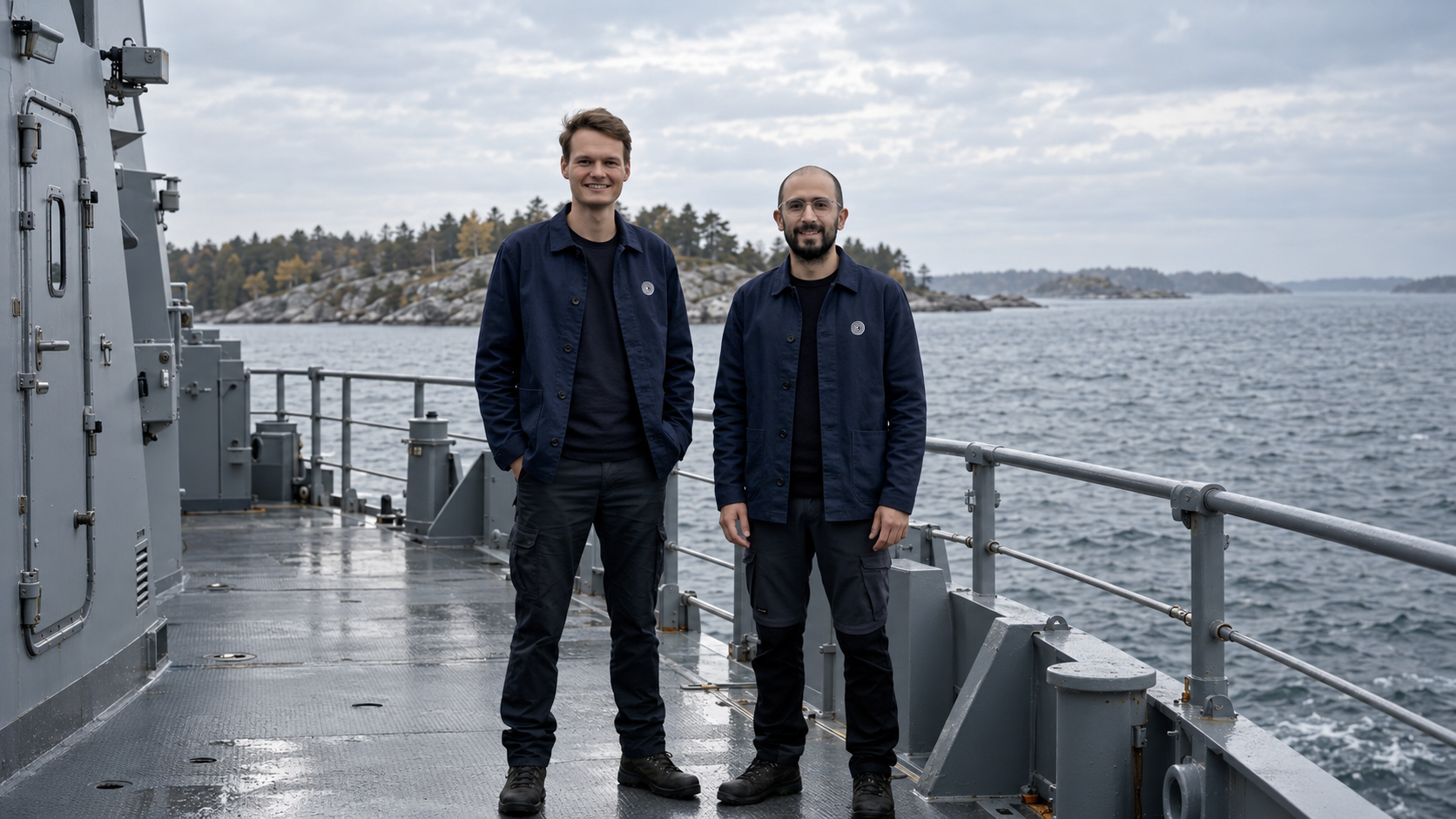
Gauthier Bouxin and Aymeric de Pontbriand are one of the strongest founding duos we’ve had the chance to build alongside, and we’re proud to support them as they develop critical solutions for Europe’s security and resilience at sea. Gauthier spent eight years as a French Navy officer, five of them aboard frigates, with deployments in the South China Sea, Bab el-Mandeb and the Red Sea. Aymeric started his career on inertial sensors at Safran, then founded Scortex, whose deep learning inspection systems ran in more than 100 factories across three continents before being acquired by TRIGO Group / Ardian. Together, they share one conviction: this invisible layer has become Europe’s most exposed frontier, and nobody is building the system to protect it.
Today, Pelagon emerges from stealth with its inception round and its first commercial deployments.
The threat is no longer theoretical. For decades, underwater warfare meant tracking enemy submarines across open oceans, a game reserved for a handful of navies. Now, surface and underwater drones are within reach of any state or armed group. In December 2025, Ukrainian underwater drones struck a Russian submarine moored at the Novorossiysk naval base. What aerial drones did to the battlefield in Ukraine is happening again at sea.
The stakes are concrete. Sabotage along cable routes, at landfalls and around installations is already routine. And seeing underwater is hard: salt water wears down hardware, and in crowded ports, sound bounces off the surface and the seabed until threats disappear into the noise. An underwater drone moving at walking pace can leave only minutes between the first alarm and impact. The sonar systems built for the open ocean were never designed for this.
Pelagon’s answer is what the founders call interdiction: detection and response working together, as a single system. The company designs, deploys and operates protection zones around ports, naval bases, offshore energy sites and subsea cables, for both European and Allied navies and civilian operators, as a fully managed service.
“Underwater, physics decides everything. Sound bends, reflects and fades, and a model trained in one harbour can fail in the next. We are bringing recent advances in physical AI and top scientific talent to one of the hardest problems there is: seeing underwater. But we don’t stop at the model. We design the whole system, from sensor to interceptor, to reach the performance and iteration speed this mission demands.” - Aymeric de Pontbriand, co-founder, co-CEO and CTO of Pelagon
The Pelagon team has already achieved significant proof points:
- At sea within months: Operations began in early 2026, and the technology was in the water by the first half of the year.
- A successful live trial: In May, ORCA demonstrated real-time detection, classification and mapping of uncrewed surface vessels in Karlskrona, Sweden.
- Commercially deployed: Operating in the Mediterranean since August, with the Baltics and Black Sea scheduled before the end of 2026.
- A full system, built in-house: From the PEARLS sensor network and ORCA AI model to the MARLIN interceptor and Pelagon OS, the team owns the whole chain, from sensor to interceptor.
- Navies and civilian operators: Delivered as a fully managed service for European and Allied navies as well as ports, offshore energy sites and subsea networks.
- Sovereign by design: European and ITAR-free, with teams in Paris, Marseille and Amsterdam.
We are delighted to support Pelagon in its inception round alongside Bpifrance, Elaia and Seedcamp, as well as defence entrepreneurs, families from the European defence industry and AI researchers from leading labs including FAIR and OpenAI.
“Europe has built new defence champions in the air and on land. The sea is a unique environment; history has shown winning at sea requires a dedicated champion that can run research, build hardware and deploy in the field under one roof. Given the size of the attack surface civil operators also need an integrated and managed solution. That is the company Gauthier and Aymeric are building,” highlights our Partner Raphaël Vullierme.
The funding will expand the team across AI research, software, signal processing, sales and institutional relations, and support new deployments with navies and operators of ports, energy sites and subsea networks.
We’ve watched Gauthier and Aymeric go from a shared conviction to systems in the water in less than a year. Naval experience and physical AI rarely sit in the same founding team; at Pelagon, they do. We’re proud to have built Pelagon with them and we’re with them all the way. 💙
You can meet the team at Euronaval in Paris, from 3 to 6 November (Hall 6, booth I135). To learn more, visit Pelagon.